Why Budgets Fail and What Works Instead
I’ll never forget the day I realized my carefully crafted spreadsheet budget was completely useless.
I had color-coded categories, formulas that would make an accountant weep with joy, and projections that looked perfect on paper. Yet somehow, I was still stress-buying coffee every morning and impulse-purchasing things I didn’t need on Amazon.
Sound familiar?
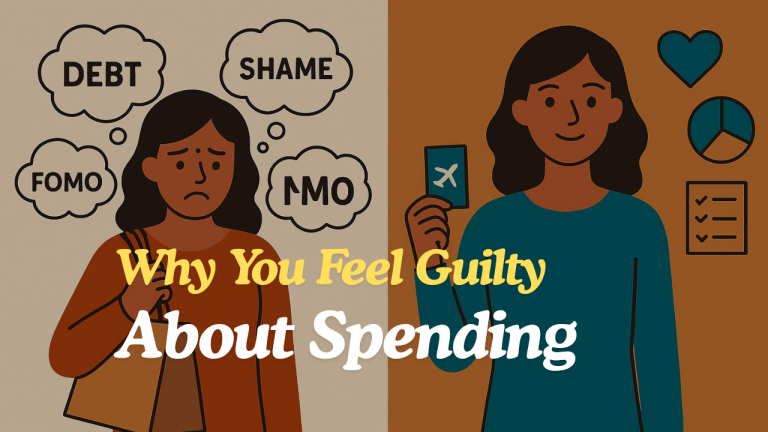
Here’s what I’ve learned: Doing well with money isn’t necessarily about what you know. It’s about how you behave.

Key Takeaways
- Traditional budgeting fails because it ignores the psychology behind our financial decisions
- Your “Wealth Identity” is shaped by three key factors: behavioral biases, personal values, and money archetypes
- Understanding why you make certain financial choices is more powerful than just knowing what you should do
- Small behavioral changes, aligned with your values, create lasting financial transformation
- Technology and human guidance work best together to overcome deep-rooted money patterns
- Try SenseFi to discover your unique financial personality and build a budget that actually works for you
The Problem with Traditional Financial Advice
We’ve been taught that personal finance is purely mathematical. Income minus expenses equals success, right?
This approach assumes we’re all perfectly rational beings who make logical decisions to maximize our financial well-being. But if that were true, why do so many of us struggle with money despite having access to all the “right” information?
The traditional financial model treats us like robots. It assumes we operate in a vacuum, free from emotions, childhood experiences, and social pressures.
But here’s the reality: psychological influences, cognitive biases, and social pressures affect the financial behaviors of investors and practitioners alike.
Think about it. Have you ever:
- Held onto a losing investment way too long?
- Splurged on something expensive after getting a bonus?
- Made a financial decision based on what your friends were doing?
- Felt paralyzed by too many investment options?
That’s not a character flaw. That’s being human.
Enter the Wealth Identity Score: A New Way to Think About Money
Instead of focusing solely on numbers, what if we started with understanding ourselves? That’s where the concept of a “Wealth Identity Score” comes in.
It’s not a single number, but a comprehensive framework that looks at three key areas:
1. Your Behavioral Biases Profile
We all have predictable patterns in how we handle money. Some of the most common include:
| Bias | What It Looks Like | Why It Happens |
|---|---|---|
| Loss Aversion | Selling winning investments too early, holding losers too long | The pain of a loss is felt 2.25 times more intensely than the pleasure of an equivalent gain |
| Mental Accounting | Treating bonus money differently than salary | We mentally categorize money based on its source, not its actual value |
| Anchoring | Fixating on the original price you paid for a stock | We rely too heavily on the first piece of information we receive |
| Herd Behavior | Making financial decisions based on what others are doing | FOMO drives us to “keep up with the Joneses” |
Here’s what’s fascinating: these biases aren’t random quirks. They have actual neurological roots.
Your emotions aren’t getting in the way of good financial decisions; they’re an integral part of how your brain processes money choices.
2. Your Values & Goals Compass
This is where traditional budgeting gets it backwards. Instead of asking “Where should I spend less?”, values-based budgeting asks “How can I invest in the things most important to me?”
When I shifted my mindset from restriction to intention, everything changed. Instead of a budget that felt like a straightjacket, I had a financial plan that actually excited me because it was connected to what I cared about most.
Common values that drive financial decisions include:
- Family and relationships
- Financial security and peace of mind
- Education and personal growth
- Health and wellness
- Philanthropy and giving back
- Freedom and flexibility
3. Your Money Archetype
Are you naturally a saver, spender, investor, or somewhere in between?
Money personalities typically fall into categories like investors, savers, big spenders, debtors, and shoppers, but understanding your archetype isn’t about putting yourself in a box.
It’s about recognizing your natural tendencies so you can work with them, not against them.
For example, if you’re naturally a “saver” who’s “hesitant to take risks,” you’re likely exhibiting high loss aversion.
Understanding this connection helps you move from “I just don’t like investing” to “I can learn strategies to become more comfortable with calculated risk.”
From Awareness to Action: Making It Work in Real Life
Knowing your biases is step one. Step two is building systems that account for them:
Beat Procrastination with Automation
If you tend to put off financial tasks, implementing a pre-commitment strategy through automated savings and investments removes the need for willpower.
Your money gets allocated to your goals before you can spend it impulsively.
Overcome Loss Aversion by Reframing Risk
Instead of viewing market volatility as a threat, try thinking of it as the “admission fee” to participate in long-term wealth building.
This simple mental shift can help you stay the course during market downturns.
Combat Anchoring with Pre-Set Rules
Make your buy and sell decisions when you’re calm and rational, not in the heat of the moment. Having predetermined targets removes emotion from the equation.
The Power of Understanding Your “Why”
Here’s what I wish someone had told me earlier: your financial mindset is shaped by many factors, from early experiences to the values and beliefs you carry into adulthood.
Maybe you grew up in a household where money was scarce, leading to either extreme frugality or a “spend it while you have it” mentality.
Perhaps you learned that money equals love, security, or status.
These subconscious ideas drive your actions and can unconsciously undermine even the most well-intentioned financial goals.
The beautiful thing about awareness is that it gives you choice. Once you understand why you do what you do, you can start making conscious decisions instead of operating on autopilot.
Technology + Human Insight = The Sweet Spot
We’re living in an exciting time where technology can help us understand and overcome our biases in ways that weren’t possible before.
AI can analyze your spending patterns, predict potential pitfalls, and even gamify the process of building better habits.
But here’s what technology can’t do: it can’t hold space for your fears about money, help you process childhood financial trauma, or guide you through major life transitions.
While technology is effective at automating solutions to certain biases, it lacks the human touch required to address the deeper psychological underpinnings of financial identity.
The magic happens when we combine both.
Your Financial Identity Is Not Set in Stone
One of the most liberating realizations I’ve had is that your relationship with money can change. You’re not destined to repeat your parents’ financial patterns or stay trapped by past mistakes.
True financial freedom is not defined by the sheer accumulation of wealth, but rather by the ability to control your life and align financial choices with a deeper sense of purpose.
Where Do You Start?
The journey to financial well-being begins with one simple but profound step: understanding yourself. Instead of jumping straight into another budget that you’ll abandon in three weeks, try this:
- Identify your patterns: When do you make your best and worst financial decisions?
- Explore your values: What matters most to you, and how can your money support those priorities?
- Recognize your biases: Which of the common behavioral patterns do you see in yourself?
- Design systems that work with your nature: Don’t fight your tendencies; build guardrails around them.
Remember, building a financial plan isn’t just about being practical; it should also be meaningful.
When your money management aligns with your values and accounts for your human quirks, it stops feeling like a chore and starts feeling like self-care.
Ready to discover your unique financial personality?
SenseFi uses behavioral science to help you understand your money patterns and build a budget that actually sticks.
Instead of fighting against your natural tendencies, learn to work with them. Try SenseFi for FREE today and take the first step toward a healthier, more intentional relationship with money.